Showing posts with label $DJIA. Show all posts

Sunday, 6 September 2020

Week to Sep 4th

Firm tech and general correction, Softbank ‘whale’ revealed, DJIA component change
MY CALL THIS WEEK : BUY AUDNZD


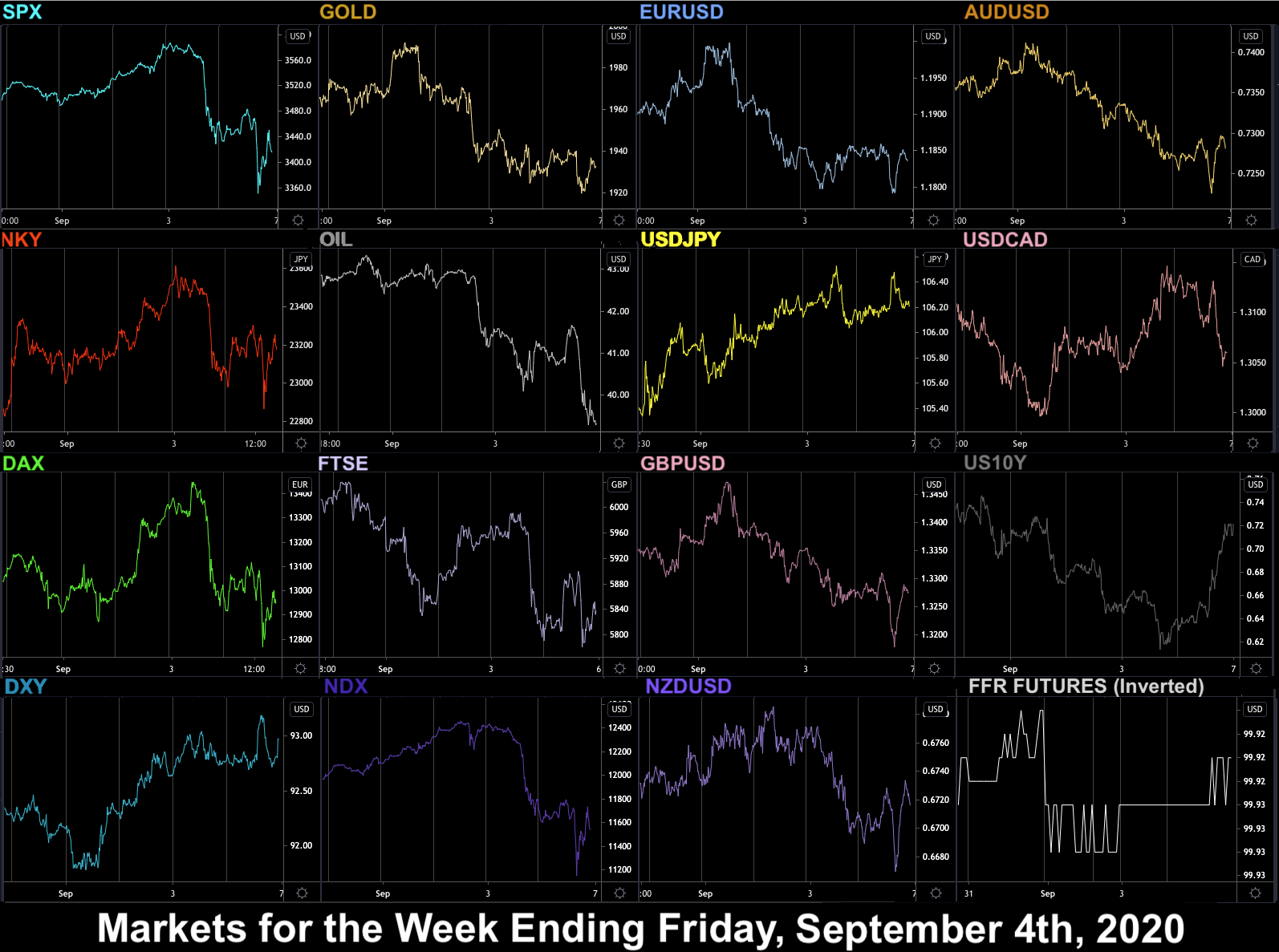
This week saw the most significant market splits (AAPL and TSLA) for years, and the market close its best August since 1986, making new all time highs in SPX and NDX. On Wednesday, NDX broke 12400, a 24% gain in two months. The next day a bubble burst, with NDX shedding 650 points, its third-largest ever point drop (and in the top 30 worst days ever). This was later confirmed to be partly due to a ‘whale’ buyer SoftBank driving up particular stocks in the tech market to extreme levels.

The DJI/NDX ratio touched 2.317 this week, a level only seen once before in the second week of March 2000. Also VIX touched its highest level since June, and notably had been rising since August 26, a rare example of index/VIX positive correlation.

There was no particular news trigger on Thursday. It was a thin news week, with only the ISM PMI (beat) on Tuesday and the ADP (miss) on Wednesday. Friday’s NFP miss may have contributed to a further fall. At the lowest point on Friday, the index was 10.3% down in two days, but still only back to the level three weeks ago.

Next week is also very thin on US macro news, with Friday’s inflation report the only print of note. We can therefore expect sentiment-driven two-way enhanced volatility which invariably follows sharp drops.

Monday August 31
It was the first day of the newly constituted DJIA today. Markets took a breather today and pulled back slightly, although NDX advanced again, and all three US indices recorded their best August since the 1980s. TSLA ramped 13% after its 5:1 stock split. Non-US indices did not join the party, both DAX and FTSE were down on stronger currencies.
Oil was down in line with the pullback. The dollar continued down, except surprisingly against JPY. However the other two haven assets move up in line with the equity fade.


Tuesday September 1
Another up day, lead by tech. AAPL was up nearly 4% (over 7% in two days), adding 0.28 points to SPX on its own, which made a new ATH. Note AAPL’s weight in SPX, at 6.89% (a market cap weighted index) is now much more than it is in DJIA (an absolute share price weighed index). Lockdown darling ZM was up 40% on earnings. Oil was up in line. DAX was flat, and again FTSE on strong sterling, touching 1.3480 for the first time in 2020, 

However the RSI reading on SPX today of 83, and this fragility may be reflected in the fact that all three haven assets were up today. USD was up, after DXY touched a new 2-year low of 91.75 but this was mainly due to weak EUR after the German Manufacturing PMI miss. 


Wednesday September 2
Yet another up day, but this time with DJIA outperforming NDX, with the markets shrugging off the ADP 50% jobs miss, but who can tell with jobs figures these days. DJIA stalwart KO was up 4%, whereas AAPL fell 2%. Surprisingly, Oil fell despite the EIA beat at 1530 and buoyant equities. The dollar turned up from its low, advancing across the board. Gold and JPY fell in line with equities, but yields followed the dollar.


Thursday September 3
After a quiet morning, markets fell very sharply, in a move reminiscent of Jun 11 (also a Thursday), with SPX down 3.5% and NDX nearly 5%. AAPL fell 8%. Global markets were also down, but by much less. Oil was down in line. There had been trade and PMI misses, but these were not really the trigger. In fact, nobody was surprised after the massive run up in tech stocks recently, and many commentators talked about a ‘healthy’ correction. Other asset classes were not correlated, showing this was not true risk-off. Gold and bonds were both down. The dollar was generally flat with CAD gains balancing GBP losses, and a flat EUR. Notably Bitcoin dropped 10%, its worst day since March.


Friday September 4
With very little regard to NFP (jobs slight miss but a strong beat on unemployment), the carnage momentum continued for a second day, although a late rally pared losses. For example, AAPL at one point was a further 6% down, although it managed to claw all that back and close green. TSLA was a similar story, dropping nearly 9% then recovering to close 2.8% up. Losses were still deeper in tech at the close, although the story for the week was more modest, with NDX underperforming SPX by less than 1%. Oil was down in line, more sharply in a delayed reaction (it closed at lows). This time Gold and Bonds were up in line. USD had another directionless day, closing slightly up, mainly on CAD weakness.

Today Japanese tech investor Softbank was revealed as the ‘whale’ behind the recent huge rises in tech stocks, an options strategy which is now complete.


WEEKLY PRICE MOVEMENT
NDX was the weakest index and biggest mover. AUDCAD made the largest move (1.38%) in forex. BTCUSD finally moved after weeks in the doldrums, although ETH was flat, and FANGS, in the end, roughly tracked the general NDX index.

My NZDCAD short paid off. The pair gapped down (not counted) and ended up 0.41% on the week. running total 6.32%, 15 wins out of 30. This week I am buying AUDNZD.


Note we use Google Finance data for daily movements, listing UUP as a proxy for DXY. All references to ‘the dollar’ are based on DXY. The equity and index prices are now based on the cash close each day.

NEXT WEEK (all times are GMT)
(Calendar High volatility items are in bold)
  • Labor day short week
  • Will correction continue
  • ECB and BoC rate decisions
  • US, Germany, China inflation

Monday September 7
Today is Labor Day so US and Canadian markets are closed. A quiet day is expected.

03:00 China Imports/Exports/TB (time approx.)
06:00 Germany Industrial Production
23:50 Japan Q2 Final GDP (QoQ e-8.1% p-7.8%)

Tuesday September 8
A quiet news day in this quiet week. Keep watching election news.

06:00 Germany Imports/Exports/TB
09:00 Eurozone Q2 GDP (QoQ e-12.1% p-12.1%)


Wednesday September 9
A third day without significant US releases, so Canada becomes centre-stage. USDCAD is approaching 1.2950, its January low, so risk is to the upside.

00:30 Aus Westpac Consumer Confidence
01:30 China CPI (YoY e2.4% p2.7%)
14:00 BoC Rate Decision/Statement (e0.25% hold)


Thursday September 10
All eyes today on ECB President Lagarde, and the latest Eurozone stimulus plans.

01:00 Aus Consumer Inflation Expectations(Sep)
11:45 ECB Rate Decision/Statement (e0% hold)
12:30 US PPI/Jobless Claims
12:30 ECB Lagarde Presser
16:30 BoC Governor Macklem speech


Friday September 11
A portentous date, and in data, US and German inflation may be the most significant prints of the week.

06:00 UK Manuf/Industrial Production
06:00 UK GDP (MoM)(Jul)
06:00 Germany CPI (YoY e-0.1% p-0.1%)
12:30 US CPI (Core YoY e1.6% p1.6%)
18:00 Monthly Budget Statement

Saturday, 29 August 2020

Week to Aug 29th

Fed dovishly redefines inflation, New SPX/NDX ATH, Japan PM Abe resigns
MY CALL THIS WEEK : SELL NZDCAD


The week’s main event was the speech from Fed Chair Powell at the virtual Jackson Hole conference, stating that the rules for calculating inflation would be changed, which ultimately would lead to more stimulus or easing. This was more dovish than expected, and stocks rose and the dollar fell. Indeed that was the pattern all week, as the move had been anticipated, although the dollar fade accelerated after the announcement. Otherwise positive vaccine news from MRNA and AZ, and a continued decline of second wave cases and deaths produced straight line gains and new highs in SPX and NDX, with strong FANG outperformance agains.

Non-US indices did not follow the trend, being pushed back by currency gains. Japan came to the fore on Friday with the shock news of Premier Abe’s resignation on health grounds. The popular leader has widely been seen as the architect of recent Japanese growth (anaemic by US standards, but still an improvement on a decade ago). NKY dropped 3% instantly on the news, wiping out the week’s gains.

Next week’s main event, as always for a new month is the Non-farm Payrolls report, with another bumper estimate as furloughed workers return. The report leads into the long Labor Day weekend. Also of interest are the Trade Balance and ISM PMIs, although the week is richer in non-US news. A small sideshow is the DJIA recomposition, now headed by UNH, and with AAPL moving from nearly 12% to under 3% weight. This can only increase future DJIA/NDX divergence. The UK is closed on Monday, which will dampen forex volatility.


Monday August 24
With positive news on the vaccine from AstraZeneca, and the COVID-19 second wave continuing to recede, lockdown affected stocks (airlines, retail etc.) surged powering SPX to a new closing high, with breadth, over 400 of the index components rose. NDX underperformed. Bonds and Gold fell, and Oil rose in line with equity move. The dollar had flat day (but JPY fell), the calm before the Jackson Hole storm. As expected the RNC confirmed the Trump/Pence second term ticket. A classic risk-on day.


Tuesday August 25
With mixed economic data, but some positive China news (the ‘Phase 1 deal’ was confirmed), the market took a rotation breather, with DJIA down, and NDX outperforming SPX, but both of these edging up to new highs. Other assets were directionless, with Gold and Bonds up, but JPY down. Oil was also noticeably up (+1.88%). FTSE was down, mostly on currency moves, as USD rose against the yen, but faded against other currencies, driven by strong German sentiment data which lifted EUR.

Today the new composition of the DJIA was announced, following AAPL’s 4:1 split. RTX (formerly UTX), XOM, and PFE leave the index, and are replaced by CRM, AMGN and HON. The removal of XOM was reminiscent of the fate of GE in 2018. Like GE, XOM was once the largest company in the index, and indeed for many years the largest by market cap in the world. Founded as Standard Oil by John D Rockefeller in 1870, it has been in the index since 1928. HON was previously in DJIA, leaving in Feb 2008. All three stocks were sharply up (although CRM +26% was on earnings), although the other entrants have more weight, and thus are more important in the new composition.


Wednesday August 26
MRNA gave another promising vaccine report today and rose 6.42%, and the Durable Goods report was a strong beat, and notably today, the FTSE All World Index set a new all-time high. Note this index is still heavily American, with AAPL, MSFT and AMZN the largest components. This led to new SPX and NDX records. Oil was up in line. However bonds were flat, and Gold and JPY advanced following a weaker dollar, falling in anticipation of the Jackson Hole speeches.


Thursday August 27
Today’s main news was of course Fed Chair Powell’s speech at Jackson Hole, where he announced plans to redefine the Fed’s measure of inflation, averaging out the releases, which would ultimately mean stimulation could last longer. The latest GDP print also beat estimates, as did Pending Home Sales. Also today it was confirmed that Hurricane Laura will bypass the important oil installations in Louisiana and Texas, which depressed Oil, a rare fundamental response. Markets rose, but not in Europe (despite, for the day, a strong dollar). Gold, Bonds and JPY were all quite sharply down in line with the US equity gains.


Friday August 28
The day started just after 0500 with the shock resignation of highly-regarded Japanese Prime Minister Shinzo Abe, where NKY immediately dropped 3%, and USDJPY dropped 0.57%, and eventually 1.42% on the day. The effect continued into Europe, where indices were notably down on the day, more so than NKY which had been well 1.4% up prior to the news.

The mood changed after the PCE and Michigan CSI beats in the US session, and all US markets closed green, with DJIA going into positive territory for the year (although not a new all-time high). Of course part of the effect was the Fed announcement on Thursday. Oil was up in line.

The dollar came off sharply today after the Fed announcement, down against all currencies. EURUSD made a two-year high. Yields followed the dollar down, which also drove Gold back up.


WEEKLY PRICE MOVEMENT
NDX was the top mover in this bullish week, up 3.81%. The largest forex move was NZDUSD, up 3.06%. Cryptos went back to sleep. BTC is now routinely less volatile than stocks. FANGs of course outperformed NDX, specially FB, up nearly 10%.

A very bad week for me. My choice to short NZDJPY cost me 2.67%, moving running gains back to 5.91%, 14 wins out of 30. I’m going to try again through, this time selling NZDCAD


Note we use Google Finance data for daily movements, listing UUP as a proxy for DXY. All references to ‘the dollar’ are based on DXY. The equity and index prices are now based on the cash close each day.

NEXT WEEK (all times are GMT)
(Calendar High volatility items are in bold)
  • Non-Farm Payrolls
  • New month
  • DJIA component change
  • RBA Rate Decision


Monday August 31
The last day of the month is also a market holiday in the UK. The main news is German inflation. There is a rate decision in Colombia. It is also the first day of the AAPL split and DJIA component change. TSLA is also splitting its share 5:1 to a price of $442.68. Amazing the this was the pre-split price only five months. Note that previous AAPL splits showed no particular advantage.

23:50 Japan Retail Sales (Sun)
01:00 China PMIs (Mfr e48.7 p51.1)
01:00 Aus TD Securities Inflation
12:00 Germany CPI (e0.4% p0.0%)
13:00 Fed Clarida speech
23:00 Aus Commonwealth Bank Mfr PMI
23:30 Japan Jobs/Unemp


Tuesday September 1
The new month sees an Australian rate decision and European inflation print. There is a rate decision in Chile, and markets are closed in Slovakia.

01:45 China Caixin Mfr PMI
04:30 RBA Rate Decision
07:55 Germany Unemployment
07:55 Germany Markit Mfr PMI
08:30 UK Markit Mfr PMI
09:00 Eurozone CPI (YoY e1%)
09:00 Eurozone Unemployment
13:30 Canada Markit Mfr PMI
13:45 US Markit Mfr PMI
14:00 ISM Mfr PMI (e54.0 p54.2)
17:00 Fed Brainard speech


Wednesday September 2
In the wildly variable jobs report days, the ADP print may be significant. Otherwise a thin day for US news.

01:30 Australia Q2 Final GDP (e-0.3% p-0.3%)
06:00 Germany Retail Sales (YoY e3.0% p5.9%)
12:15 US ADP Employment Change
14:00 US Factory Orders
14:30 BoE Haldane speech
14:30 BoE Broadbent speech
18:00 Fed Beige Book
23:00 Aus Commonwealth Bank Svcs PMI


Thursday September 3
The busiest US news day is not that busy, with the ISM Services PMI the most important, and probably the Trade Balance after that.

01:30 Aus Imports/Exports/TB (TB e8.8B, p8.2B)
01:45 China Caixin Svcs PMI
07:55 Germany Markit PMI Composite
08:00 Eurozone Markit PMI Composite
09:00 Eurozone Retail Sales (YoY e-0.5% p1.3%)
12:30 US Trade Balance
12:30 US Jobless Claims
13:45 US Markit PMIs
14:00 US ISM Services PMI (e57.1 p58.1)
14:00 BoE Governor Bailey speech


Friday September 4
The jobs report is the key takeaway for today as we go into the long Labor Day weekend.

00:30 Aus Retail Sales (e3.3% p3.3%)
06:00 Germany Factory Orders
12:30 US NFP/AHE/UnEmp (NFP e1.55M p1.76M)
12:30 Canada NFP/AHE/UnEmp (NFP e400k p418.5k)
14:00 Canada Ivey PMI

Sunday, 13 November 2016

USD is rising post-Trump, or is it?

On the weekend after the Trump victory, we have seen a huge increase in equity prices, with the DJIA reaching an all time high. This was to be expected with an across-the-board Republican victory, not only winning the White House but both houses of Congress. However, what was not expected from a protectionist was a rise in the value of the dollar.

The initial panic spike sold the indices and the dollar. If we take Brexit as a comparison, the indices quickly recovered but the currency (GBP in that case) didn't. So what happened in America?

Well, the resolution of uncertainty was likely to favour USD, whoever won, mainly because risk is reduced. But Trump’s infrastructure development plans, to create jobs, and his tax cuts, are perceived as inflationary, hence why USD is rising contrary to the view of many pre-election pundits. Trump’s five minute off the cuff acceptance speech seemingly transformed him from huckster to statesman in an instant, making his plans realistic, especially given the all Republican government.

It is obvious why this is good for equities, and better for the DJIA than the SPX, better for the SPX than the NDX and so on. Building schools, hospitals and roads, and increasing insurance profits by abolishing Obamacare is great for the giants in the DJIA (including the banks that fund them), but doesn’t help the tech industry at all. Trump wants to tighten immigration and cut taxes. Silicon Valley pays little tax anyway, due to the 'cyberspace' location of it's business, but more tellingly 37% of it's workers are non-citizen immigrants.

It is less obvious that Trump is good for USD. So we have to ask - is USD actually rising? Or is it just that other currencies are falling.

Remember US protectionism is per se bad for other countries. If Trump raises tariffs, then to maintain competitiveness, foreign currencies have to fall. We already know about Trump’s whipping-boy MXN, but EUR is suffering a similar fate, as TTIP, nearly completed, is now likely to be cancelled.

Japan of course is a huge exporter to the US, so naturally JPY fell, rumoured to be assisted by a BoJ dollar purchase.

AUD initially showed little effect, and the drop in the AUDUSD pair is probably more to do with the sharp fall in gold, itself being driven by risk-on in equities rather than USD itself. Even gold expressed in EUR is down nearly 3% from it’s pre-election low, and 4.6% from it’s pre-election November high.


A chart you don't often see - Gold in Euros


By contrast, the one country the Brexit-loving President-elect has moved from the back to the front of the queue is the UK. This indicates an economic oxymoron;  a union of isolationists. GBPUSD has soared 2% , EURGBP has given up 5% this week. The British Europhile tourist paradoxically has Trump to thank.

The final test should be on another isolationist currency, with little skin in the game, the obvious candidate being the Swissie. USDCHF has finished the week only slightly up, and 100 pips below it’s October high.

This DXY chart, for the last 30 days, shows that USD across the board appreciation is far from clear. Of course most of DXY's weight is EUR and JPY.


One can imagine Trump finds resonance in Gore Vidal's quote "It is not enough that I succeed, everyone else must fail". Don't forget Vidal's most famous quote is "Never pass up a chance to have sex or appear on television".

I'll leave you with this YouTube clip

Thursday, 24 September 2015

Update on DJIA and EURUSD

Following yesterday's posts, the DJIA has performed exactly as I said it would, falsely breaking out of the black tramline channel in the overnight and European session, and then returning sharply into channel when US buyers arrived. Here is the chart at 12:30 UK time.


It is perfectly clear that one of these tramline sets is working, probably the black one, but in any event, a drop to 16025 seems inevitable in either scenario. In short we are still selling rallies.

EURGBP has been similarly successful since this morning's post. It has smashed through the 38.2% target and is well on it's way to my ultimate 50% target of 1.1280. I took half off at 38.2% as per my plan. I don't regret this. Sticking to a plan is more important than today's profit.


Note I am learning to use MT4 for my currency trades.


Wednesday, 23 September 2015

Course article on the DJIA today

As promised, here is a piece I wrote today for my course about the movement of the Dow Jones Industrial Average (DJIA), with some background on the index, and it's behaviour today. Some knowledge is assumed.

The Dow Jones 30-share industrial average is the most visible market in the world, quoted as THE market in layman's business news. It is also the most traded index after the DAX for European index daytraders. IG Markets, the UK's largest spreadbet firm tell me that over half their entire business is the DAX and the DJIA. You must never call it DOW, as that refers to a chemical company.
It is traded in the US via the DIA ETF, often called the 'Diamonds' like SPY is called the 'Spider', although there, it is nowhere near as popular as SPY. If we are being strict, SPY and DIA are both 'spiders', as they are both ETFs which are 'Standard & Poor Depositary Receipts', but the name is principally used for the S&P 500 ETF.
The symbol given to the cash index (as traded 0930-1600 New York time) by most retail traders is DJIA or ^DJI although older commentators use the official ticker code of INDU. The Dow futures are referred to by the code YM_F (all futures are like this, gold is GC_F, oil is CL_F, copper is HG_F, (oddly not CU_F, there is no futures market in mercury!), and so on. How many of you knew that EURUSD futures (or strictly forwards in FX) are called 6E_F.
Anyway, back to the DJIA. Because it is primarily traded by European retail traders through spreadbetting or CFDs, the price is normally given as a blend of futures and cash, allowing spreadbet brokers to quote a near 24 hour price. All this is background to a couple of charts I am posting, which I also posted today on Twitter. Here is the first one, which is self-explanatory.

I posted this at 11:05 UK time on Sep 23rd, and it shows two possible parallel channels (tramlines) which the index is following. You can see that the index was nearly touching the black channel, with a steeper downward gradient than the red channel. Both channels had multiple touches, but there are more on the red channel, which gives it higher validity. So a black channel believer would short here, whereas a trader who preferred the red channel would wait until about 16450 to short, or even go long up to there. Note the dilemma
1. Both channels are down, so shorting has a better risk/reward, ie is safer.
2. The red channel has more touches, so appears to be more valid.
The right answer of course is to wait. The three sharp hourly candles that raised the index by 175 points commonly cause short-term exhaustion. This might also be expressed as being overbought on the short-term RSI, although traders rarely use RSI for periods of less than a day. So let's see what happened. The next chart was posted after the end of the day.

At 12:00 UK time, which is 7am in New York, where the first traders get to their desks, the index briefly spiked. It was only a spike, you can see the large candle tail (called a 'shooting star') briefly break out from the black line and retreat. The rest of the day was inside the line, with, unsurprisingly another attempt at the end of the day when the volume builds up. Note also that the low of the day was much higher than the futures low from the previous night - which had been depressed by Chinese news. That low was caused by Asian traders, selling YM_F on the Globex market, in relatively small volumes. Europe was less concerned hence why it shot up in the morning (and to an extent followed European indices).
So what will happen now. It is clear that we have a pattern of Asian bearishness, European bullishness, and US bearishness. We need to look at the DAX, which will drive YM_F tomorrow morning.


The DAX is in a downtrend, although having hit channel bottom overnight, duly performed a rally. When nothing happens overnight, you can give reduced credence to breakouts, as in the false breakout of the night of 21/22 September, which was quickly corrected when the cash market opened the next day.
The DAX has now moved to being very close to the top of it's downward channel. The US session dragged it down, or was it just technicals that did that. Note the channel is very precise despite the effect of the VW, BMW and MB share crashes. Indices are like that, the money has to go somewhere else in the index (some funds can only buy the 30 DAX shares, although they have freedom to pick which ones).
The DAX downtrend gradient is quite steep, and I will be watching closely to see if there is a breakout tomorrow. If there is, then I will check if YM_F follows suit. I will then check if the YM_F breakout spikes and does not correct around 1200 UK time. All three must be true to change my bearish view.
Otherwise I will continue to short rallies. Buying dips seems so long ago in this market.